Morkel and Jonkershoek junction
The Morkel-Jonkershoek junction is designed for flow of traffic, yet it is within a woonerf and many young children use the pedestrian crossing to and from school. Drivers are known to not stop at the junction’s pedestrian crossings. A simple redesign will drastically improve the safety for young children.
It is known to local parents that the right-of-way at the pedestrian crossings on the junction of Morkel and Jonkershoek are ignored by many drivers. This is of great concern as the junction is popular with young children making their way to and from the nearby school. A natural reaction is to demand that someone should do more to enforce the rules, however this junction has not been designed with pedestrian safety in mind, even though it is within a woonerf. So let us explore how the junction might be redesigned with a focus on pedestrian safety, particularly for children.

The junction is currently a large, open, stop junction with a turning lane and two small pedestrian crossings.

By quick inspection one can immediately see why some drivers (inadvertently?) ignore the Jonkershoek road pedestrian crossing, it is much too close to the junction. The driver turning left from Jonkershoek road onto Jonkershoek road towards town will naturally be checking right for vehicles on Morkel road and when clear will then begin to turn and almost immediately be on the pedestrian crossing.
Fix 1- Move the pedestrian crossing further from the junction.
Move the pedestrian crossing further from the junction so that drivers clear the junction and meet the pedestrian crossing head on and full driver attention is straight ahead. Allowing enough room for the driver to clear the junction helps with traffic flow, the driver behind can still turn right even if the current driver is held at the pedestrian crossing.

Fix 2 – Replace the turning lane with a traffic island.
In the current configuration a child crossing the pedestrian crossing must negotiate three lanes of traffic in one movement. If the turning lane is replaced by an island, then the children have refuge in the middle and need only negotiate one traffic lane at a time, a much safer scenario for them. (We must speak and design assuming there is no pedestrian crossing, because there isn’t one if too many drivers ignore it).

A second and rather subtle concern with the filter lane is that filtering traffic can block the sight line of the through traffic lane drivers and so a crossing child may only be seen at the last moment by the through-lane driver. An island will ensure children are seen at all times by drivers approaching the junction.

Immediately one might worry about traffic building up if the filter lane is removed. Should there be a large volume of traffic build up at specific times, that would most likely be through-traffic, and this is a woonerf. The through traffic doesn’t have to be accomodated at the expense of childrens’ safety crossing the road in a woonerf, the unnecessary through-traffic can be dealt with in other ways.
Fix 3 – Add small traffic islands on Morkel road pedestrian crossing.
Add small traffic islands on the Morkel road pedestrian crossing, this gives refuge to the children crossing so that they need only negotiate one lane at a time which is much easier and safer task. Moreover, the traffic islands can be used to narrow the width of the lane so that drivers naturally slow down at the junction.
Fix 4 – Tighten the corner radius at Morkel onto Jonkershoek.
The corner radius is too large and encourages higher speeds. Tighten the corner radius and consider traffic islands also. The local Spar shop attracts pedestrians from Mostertsdrift, so a safe crossing at this point is also useful.
Fix 5 – Reduce the speed limit from 35km/h to 30km/h
For those who observe speed limits, making a small reduction in the limit is worthwhile. Injuries are less life threatening at lower speeds, and even a small change will make a real difference.
All the fixes
Together the fixes applied to the junction would look something like this;
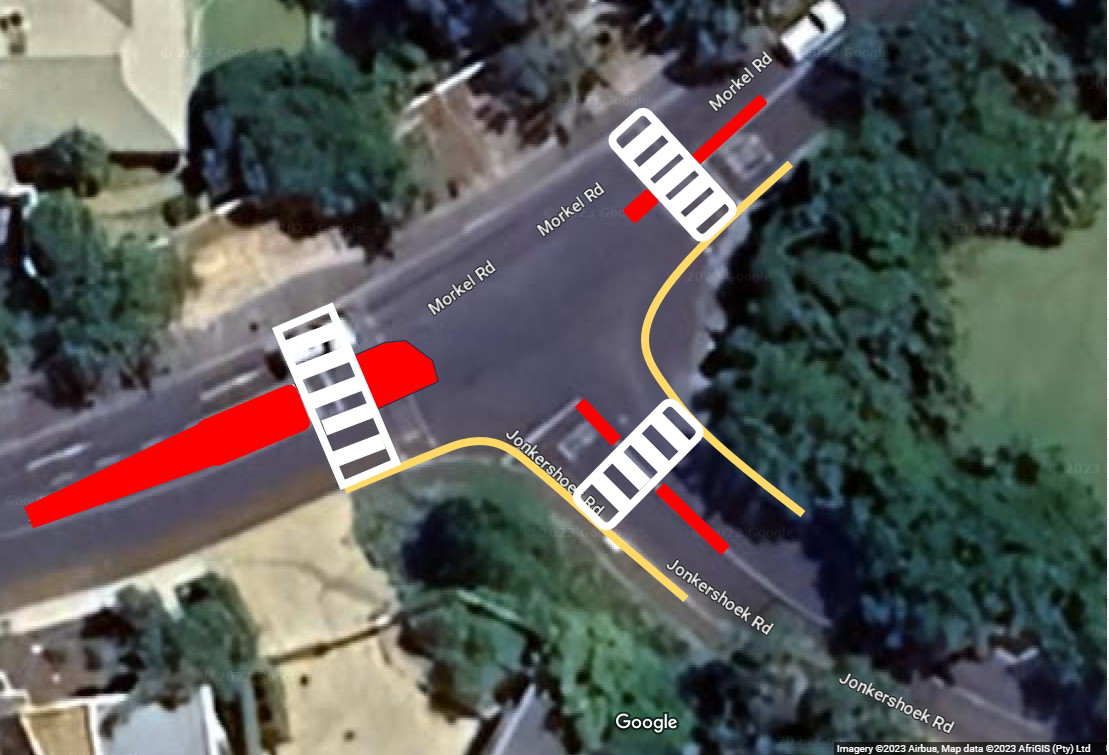
I did leave out the notion of raised intersection with bricked roadway instead of tarmac, this is a well-known improvement to junctions within woonerfs in general, and has been applied in the local area at several places, and is a welcome addition, but the fixes above are more important.
It is also worth noting that some of the fixes can be tried and tested in a temporary experiment at very little expense. For example, temporarily closing the filter lane and adding traffic islands can be done with planters and traffic cones, and yet has the possibility of immediately improving the safety of the junction for children.