Endler and Martinson Junction Upgrade
A quite dramatic junction upgrade was recently completed at Endler and Martinson in Stellenbosch. The upgrade has many positive changes but fails for fietsers.
Endler Road provides access to a small gated community, the local primary school and a high school. Below, we can see the junction configuration before and after.


In the old junction there is a traffic light stopping traffic in both directions for pedestrians to cross and a hatched area to accommodate a right turning lane onto Endler in the other direction. The painted cycle lanes are approximately 1m from the curb, with an effective tarmac width of 75cm after the drainage gutter. It is a struggle to refer to it as a cycle lane.
The upgrade is quite dramatic and the engineer is to be congratulated for their boldness. The traffic light has been removed completely, pedestrians crossing only block one vehicle lane at a time, ensuring smoother flow at the junction and a safer crossing for the pedestrians. The junction is now a mini-roundabout enabling those exiting from Endler onto Martinson to do so conveniently, even in heavy traffic, remember ‘first to yield line, first to proceed’ much like a stop junction. The central hatching has been removed and the cycle lane is much wider and actually usuable now! Of course, it would be safer with kerbing to protect (paint is not protection!) yet when cycling one certainly does feel safe because the new hatching provides enough separation to the vehicle lane and vehicles are staying in their lane.
Failed design for fietsers (and pedestrians) on the mini-circle
Whilst we welcome the upgrade in general, there specific aspects which need to be revisited.
Failure 1 – Partial protection for pedestrians at the crossing
The junction has only partial protection for pedestrians between the two vehicle lanes, a kerbed island is missing from the approach to the mini-circle, only hatching is provided (paint is not protection!). For a pedestrian, it still feels like crossing two lanes of traffic instead of one lane at a time. There is an example of a fully protected pedestrian crossing in the centre of town with a much safer design even though the speed in town is lower than on Martinson. I can’t think of a good reason why this pedestrian protection was left out, could it just have been forgotten about?

Failure 2 – No protection of the cycle lane as it narrows at junction
As we see in the pictures below the painted hatching separation of the bicycle lane disappears just before the junction, the separation narrows from about 1m to 0 just at the pedestrian crossing. Beyond the pedestrian crossing the cycle lane itself narrows to just 80cm because of a drain with no protection from vehicles. Fietsers are being squeezed into the path of the vehicles, just when protection is needed most.

Now remember, this junction is for Endler, a street with the local primary school and high school. Would any parent feel comfortable with their child having no protection from cars, lorries and taxis at this junction? If a child is to cycle to school the advice from a parent would surely be to cycle on the pavement even after this upgrade of the junction! This is a failure and it didn’t need to be like this.
Failure 3 – Narrowed cycle lane and deep drainage gutter.
On the mini-circle the road has been raised but the original kerbing kept, leaving quite a drop in the road surface just at the edge of the 80cm painted cycle lane.

Imagine a high school student trying to stop at this section because of a vehicle turning into Endler. They are forced to be close to the drain by the very narrow cycle lane and can easily wobble into it and fall off. If they stay on the roadway but want to stop and put their left foot down, the foot could be in the gutter causing them to fall off their bike. With these scenarios we see there is no forgiveness for errors by the fietser in this design, this is an accident waiting to happen, a failure and it didn’t need to be like this.
An immediate solution is to use the same covering of the drain around the bend as is used at the pedestrian crossings over the drain. This widens the cycle lane and keeps the road way at the same level over the drain preventing accidents.
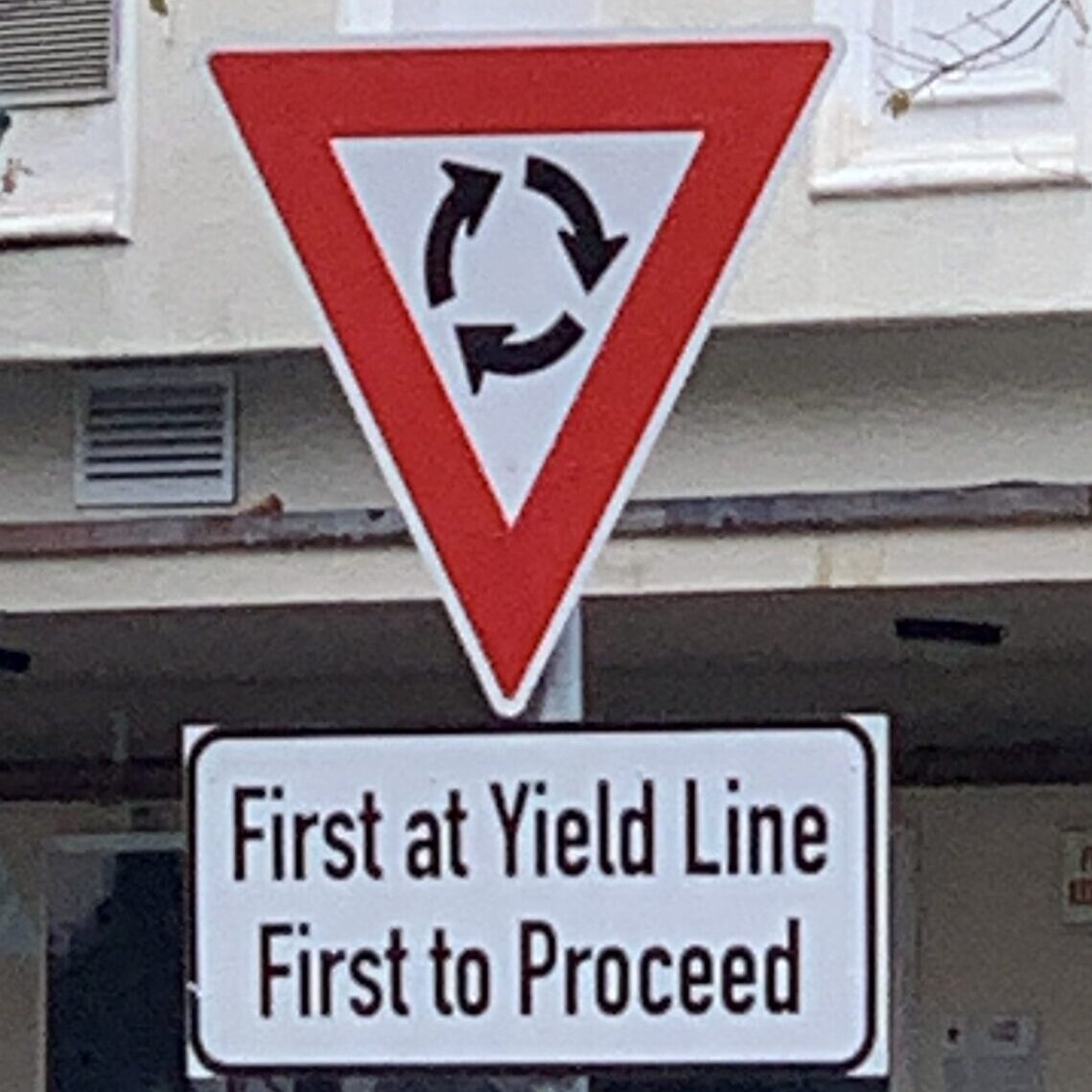
First to yield line, first to proceed.
The final curiosity I have about the implementation of the junction is that it does not include the usual ‘first to yield line, first to proceed’ sign. Of course, it doesn’t have to, but many people don’t understand this aspect of a mini-roundabout in South Africa, so I think it worth reminding folk, especially on a new mini-roundabout installation.
How could fietsers of all ages and abilities have been accomodated?
There is so much space at this junction the cycle lane can be taken off the main roundabout and put along side the pedestrian crossing so that no interactions or collisions between fietsers and drivers occur on the roundabout itself. This is more convenient for drivers and much safer for fietsers.


This idea is used by Dutch road engineers and it well-known to be a safe option. Furthermore, this approach is not new in Stellenbosch, it can be seen locally at the main roundabout on Merriman.


A refined design for Endler-Martinson junction which follows safe design principles is possible and shown below.

This design looks more elaborate than the current design, but each aspect of the junction provides safety for pedestrians, fietsers and drivers alike. Parents would be much more confident in allowing their children to use a junction with this inherently safe design. Enabling children to cycle to school reduces the number of vehicles entering the junction at peak times reducing congestion; that is, vehicle drivers would also benefit indirectly from safe high quality bicycle infrastructure at this junction.
Feedback
Dawid Botha says
September 6, 2024 at 12:56 pm
“I absolutely agree with the weaknesses pointed out and the solutions. Yes, the dept of roads totally ignored the official Cycle Plan of 2015 as updated in 2022. In fact I was told straight out: I do not agree with the design of Martinson Street in the Cycle Plan.
The proposed plans for the roundabout by different consultants were rejected I think three times by the Ward Committee and also the NMT Working Group. I do not think any of the consultants, even the one that designed the present rounabout have even designed any infrastructure for fietsers.”